

Part one in an epic four part series on how to gamify *any* lesson plan!
Last week, my students started reading Adventures of Huckleberry Finn by Mark Twain. Because the text is so rich and full of hidden “treasures” to discover, I really wanted to back off of the usual “death by PowerPoint” approach to novel study (with its customary daily reading quizzes and meat through a grinder approach to low-level content recap homework that practically begs to be copied from Sparknotes) and let the students explore the text at their own pace. At the same time, I needed some sort of easy to rinse-and-repeat instructional playbook that I could run day after day throughout the unit to ensure that even while they were working at their own paces, we’d have enough of a routine in place to ensure that students could consistently have opportunities to demonstrate their mastery of the basic story elements of a novel: symbolism, characterization, foreshadowing, setting — you get the idea.
The only problem was? I really didn’t want to have to dedicate entire class periods lecturing about these fundamentals of fiction, and it felt sort of arbitrary to select one particular concept to focus on per class day and slice and dice the text up accordingly. Monday for character, Tuesday for setting, Wednesday for… yada yada yada. Because real books aren’t written that way. A good novelist is constantly weaving each of these storytelling elements throughout the entire tea of a text, and so it just felt sort of false to focus on them in a one size fits all approach over a series of consecutive classes.
But what if there was a way to have all students looking for every one of these story elements on any given day of the entire three week long novel study? Could I simultaneously be more hands off with my teaching and let the students sharpen their critical reading skills while at the same time crafting a pedagogy that was entirely student centered and (gasp!) fun?
I took a weekend and started fiddling around with the idea of turning entire novel study into a massive multiplayer campaign. Forty eight hours later, and Text Quest was born.


(Looking to create your own totally free and fully customizable RPG dungeon map? Head to donjon!)
Text Quest is a game-based pedagogy that transforms any novel study into a living, breathing educational role playing game that entire classes can play together at a time for the duration of your unit. In the realm of Text Quest, students will band together as “guilds,” create their own period-appropriate avatars, solve asynchronous “dungeon maps,” compete against rival squads, earn precious finishers medals for high quality work products, make meaningful in-game decisions inspired by specific events from the source text, and ultimately find themselves face-to-face with an end-of-unit adversary that will test their collective powers of close reading, teamwork, writing, and communication.
If you’re an old school board game geek, think Dungeons & Dragons. If you’re a video game nerd: think World of Warcraft. And if you’ve never played either? Don’t panic! This game-inspired pedagogy functions as a “second skin” for your existing novel study, and it can be laid over any existing unit plan to help spark unprecedented levels of creativity, engagement, collaborative problem solving, and close reading of the assigned text.
This week’s blog entries will walk you through everything you need to know about the pedagogy and instructional design for each of the stages of this game. The beauty of this pedagogy is that it is both student centered and totally modular. You can use any one of these components as a stand alone activity in a single class period, or you can string them all together to create a fully gamified approach to lesson planning to provide a sprawling campaign that lasts for the duration of your unit. In brief, the three basic components of the Text Quest pedagogy are as follows:
- Lucky Dice Warm-Up (2-3 minutes)
Student teams will reflect on the previous night’s reading using a dice rolling scenario. - #Hashtag Hunt (10 minutes)
Like an asynchronous trek through a treacherous dungeon, Teams will dig through the previous night’s reading for specific items of text evidence. - Seminar Showdown (30 minutes)
Two student teams will join in an “inner circle” for Socratic Seminar while the other two teams observe silently in the “outer circle.” At the midway mark of the seminar, the two groups will trade roles so that all students will have taken part in both activities each day.
Ready to roll? Awesome. Let’s start with the supplies:


Role Playing Game Dice
Students will be divided into competing teams for the duration of this activity, so each class will need four identical bags of seven RPG dice, including d4, d6, d8, d10, d10 (00-90), d12, d20). Sets of five identical bags of RPG dice retail on Amazon for $9.99. Teachers wishing to expedite class gameplay by eliminating physical dice rolling can consider installing one of the many free RPG dice apps available on their smartphone.
How to play Text Quest – Step One: The Lucky Dice Warm-Up


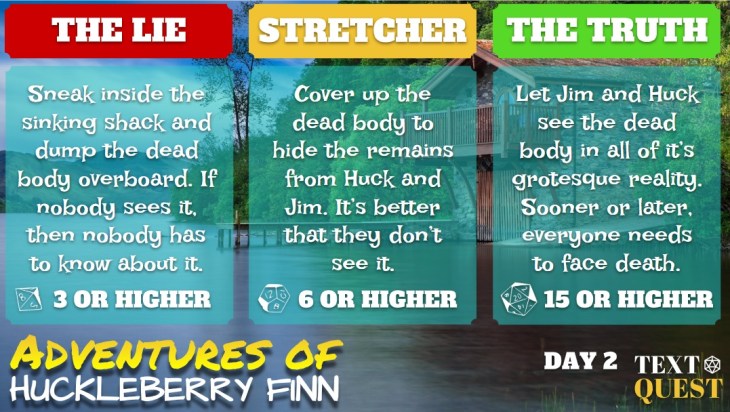


Like a traditional role-playing game, each of the three of the choices comes with a different success/defeat threshold to determine the group’s course of action. Easier choices offer lower thresholds for success (example: roll one d8 higher than 3 to succeed), while more difficult moral dilemmas offer a higher threshold for success (example: roll one d20 higher than 15 to succeed). Each raft will keep track of their team’s daily dice rolls along with their corresponding success or failure for that day’s prompt using one of the three circled icons and the corresponding checkbox on their team score card.
Naturally, these choices and their respective success/defeat thresholds will escalate in difficulty as the novel progresses, offering players with greater risks that yield greater rewards as the game unfolds. The team with the highest dice roll for the day’s Lucky Dice Warm-Up will have the first choice of look-for item selection for the day’s #Hashtag Hunt (with success/defeat indicators serving as a tiebreaker).
So what the heck is a #Hashtag Hunt?
Check back in tomorrow and we’ll take a closer look!