

Is it even humanly possible to make the process of collecting, reviewing, and grading THOUSANDS of index cards fun?
Welcome to today’s Boss Battle! Attack The Barracks: Part 2.

Last time, we talked about the first round of a gamified “boss battle” activity, in which we turned what would otherwise have been a boring old note card review process into an all-out war of students against the Big Bad computer. Super quick to set up, and super effective for providing targeted, meaningful feedback at an all-important checkpoint while students in my Honors American Literature class work their way through the otherwise arduous process of compiling 50 note cards for use in what will ultimately become a 10+ page research paper.
The Challenge:
Make the note card writing, review, and collection process even the slightest bit more joyful and engaging, so students will stop just churning out hastily created “filler” note cards of little substance and focus instead on crafting quality building blocks for research that will inevitably make their writing process SO. MUCH. EASIER.
The Game:
“Attack the Barracks.” A two day activity designed to challenge players to work individually and with teammates to critique, revise, and ensure that their note cards are up to par in preparation for the next stage of literary research paper writing. On day one of the activity, players were asked to come to class with 30 note cards to a quality standard looking something like so…
“Attack the Barracks.” A two day activity designed to challenge players to work individually and with teammates to critique, revise, and ensure that their note cards are up to par in preparation for the next stage of literary research paper writing. On day one of the activity, players were asked to come to class with 30 note cards to a quality standard looking something like so…

On the first day of the game, students brought 30 note cards into class apiece and “battled” the Big Boss computer by scoring points for individual note cards that were formatted to standard in order to get the hang of what did — and DIDN’T — count as a quality piece of research annotation. At the conclusion of class, students were instructed to take all of their materials home, and prepare for the Big Boss battle rematch by getting all of their note cards up to snuff. And if they learned what they did wrong on day one and corrected a bunch of their note cards along the way? Win/win. Not only will it improve their grade (and their eventual research paper) — it’ll likewise improve their gameplay.
Because on day two: each student will need a total of 50 quality note cards apiece. And this time, I’m collecting EVERYTHING when we’re done.
Ready to play?
The Premise:
For today’s game, player groups (teams of 4-5) will work together to review, critique, and swap properly formatted note cards in exchange for individual “bricks” that each team can use as they create the strongest research paper barracks possible.
BUT.
- Keep a sharp watch for defective bricks.
- Protect your team from Destroyers.
- And look out for spies!
The Setup:
Setup took about 10 minutes for the 86-minute block class, but that was mainly due to the simple fact that I was about to be collecting some 2,000 or so individual note cards from students — and so I wanted to make sure that nothing got lost in the shuffle. To do so: every student flipped their completed note cards face-down on their desks and spent the first 2 minutes of class WRITING THEIR INITIALS IN GIANT. FREAKING. LETTERS. ON THE BACK OF EVERY. SINGLE. CARD.
To make everyone’s life easier, students were divided into four teams, and — using roles inspired by the four gamer types reflected in The Bartle Test — each player type had a special power. Each team member had the choice of what character they would like to play for their team (all groups needed at least one player of each type, with extra players doubling up as need be).

Materials Needed:
To echo the concept of how note cards function as “building blocks” for a well-structured research paper, today we’ll be using actual LEGO bricks — with the ultimate goal of building the coolest LEGO fortress that you possibly can. If you’ve got an old tub of these puppies kicking around the house (or a friendly colleague with young children) — you’ll probably need about a thousand pieces or so.
To add one last “personal” touch, I likewise provided each individual student with his or her own mini-figure to act as their avatar for the game (life hack: buy cheap off-brand LEGO minifigures in bulk!). The only rule was that every character’s avatar had to fit into their finished “barracks” once the final bell had sounded to end the game.
Finally, you’ll need:
- Four disposable plastic Tupperware-style containers (for groups to use for holding all of their LEGO pieces as they build)
- A set of measuring cups (multicolored cups are such a win).

The Gameplay:
- Player teams roll three dice to start. Each dice rolled represents one of the measuring cups shown above (1=smallest, 5=largest). You’ll use the number rolled on each of three dice to determine which size cup you’ll use to scoop up your starting batch of LEGOs (if you rolled a six, you get to scoop with one hand. LUCKY YOU!!!).
- Send one representative from your team to “the quarry” (giant bucket o’ LEGO bricks at the teacher’s desk) to scoop your startup pile into your Tupperware container. Take your new stash of building resources back to your home group’s desk cluster.
- Introduction round: Just like every great building depends on a strong foundation, every good research paper starts with a top-quality thesis statement. You have five minutes to work with your teammates. Brainstorm, troubleshoot, refine and rewrite your thesis statement so that it is PERFECT. Once the five minutes are up, every single member of the group will be asked to read his or her thesis statement aloud to the class one at a time — and the teacher will award the team points in the form of measuring cup sizes for each group member with a perfectly-structured thesis. One perfect thesis statement = smallest cup. Four perfect thesis statements = fourth smallest cup.
- Alright, so we’ve got the hang of things and you’ve got a whole bunch of LEGOs at your disposal. But that’s not nearly enough blocks to build your barracks! So you’ll need to keep mining for resources by sending individuals back to the “quarry” for more and more bricks. To do so, you’ll be trading note cards for more bricks. But once a card is submitted for review — even if it’s not “brick” worthy — it stays with the teacher for good (just like putting an envelope in a big blue mailbox. Once it’s in, it’s gone). So choose how you spend your time and resources wisely as you go.
- The rest of the game runs like so:
- The Builder (Explorer) begins construction of the physical barracks using the LEGO bricks available in the team’s Tupperware container.
- For the time being, The Destroyer (Griefer) stays put in their home group — helping teammates with construction, brainstorming, and resource management / quality control.
- The Curator (Achiever) can take stacks of any 10 note cards at a time to “the quarry” for quick review. These can be mix-and-matched from the note cards created by any members of their team. For each individual note card that is completed to standard, the Curator gets to select one LEGO brick for their team. Keeping the card limits to batches of 10 kept things moving super smoothly, AND forced teams to work together for in-house quality control before creating long lines at the teacher desk.
- The Gambler (Socializer) can float between groups keeping an eye out for particularly well-formatted note cards that any other players might have created in their own desk groups. Gamblers can steal any one note card at a time and bring it to the quarry for teacher review. If it passes the quality control test, the Gambler rolls a six-sided dice at the teacher’s desk to determine how many individual LEGO bricks they’re allowed to select from the quarry and take back to their home group. So it pays for Gamblers to be on the lookout for top-quality note cards worth stealing!
- Set a timer on the overhead projector (10-15 minutes per round worked like a charm), and we’re off to the races as the game pretty much runs itself. Players collect, correct, and exchange resources for additional LEGO bricks by turning in top-quality note cards, while teacher is reviewing everything on the spot, and sorting submitted cards into handy student-specific piles thanks to the GIANT STUDENT INITIALS ON THE BACK OF EACH CARD.
- After the stipulated time expires? Plot twist! Destroyers get to roll two dice apiece. And they have two quick minutes to introduce a little anarchy into the game like so:
- The first dice represents the number of cards you’re allowed to steal from any one rival team (this is a great time to check in with your Gambler pal to ask which rival players have the richest stockpiles of quality note cards worth stealing).
- The second dice represents the number of LEGO bricks you’re allowed to steal from any one rival team — up to and including whatever plates the group might have used for the very foundation of their structure. AND OH THE HUMANITY AS THE STRUCTURES CRUMBLE TO THE FLOOR!!!
Helyun the destroyer @helenp317M @MeehanEnglish #kindasad pic.twitter.com/UZV3cEsMD8— Peter (@PeterP317M) January 24, 2018
-
- Swap group roles within your teams so that everybody has a chance to play a different part. Rinse and repeat till all note cards have been collected or the bell rings (in which case you’ll grab all remaining notecards at once). Tweet photos. Vote on favorites. And at the start of the next class: award badges, treasure, extra Power-Up Items, etc. etc. etc.
As for who “wins” and who “loses?
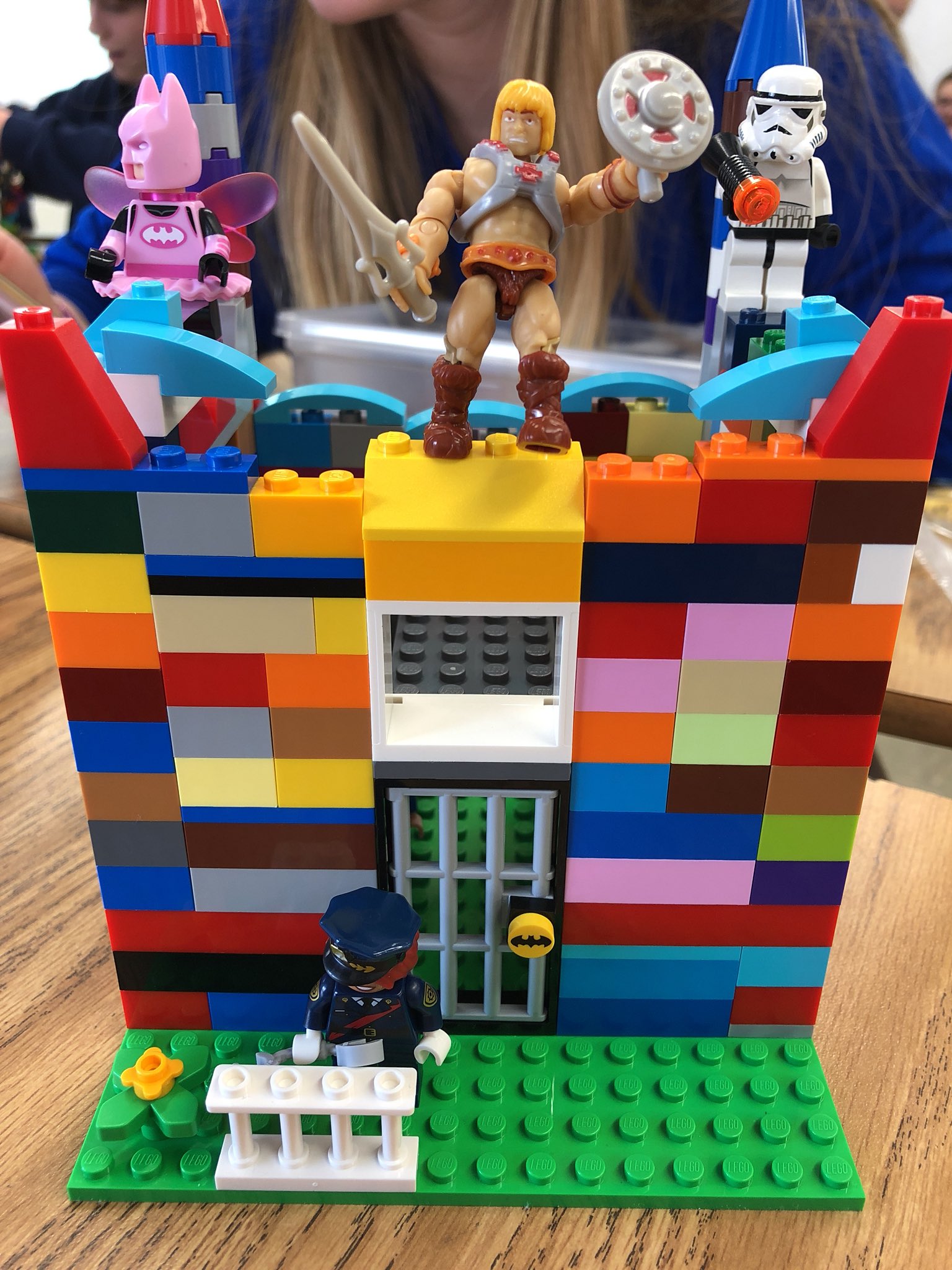
#legoprison best English class ever @MeehanEnglish pic.twitter.com/YQlt9A1kGa— Blaise Hartsoe (@BlaiseP317M) January 24, 2018
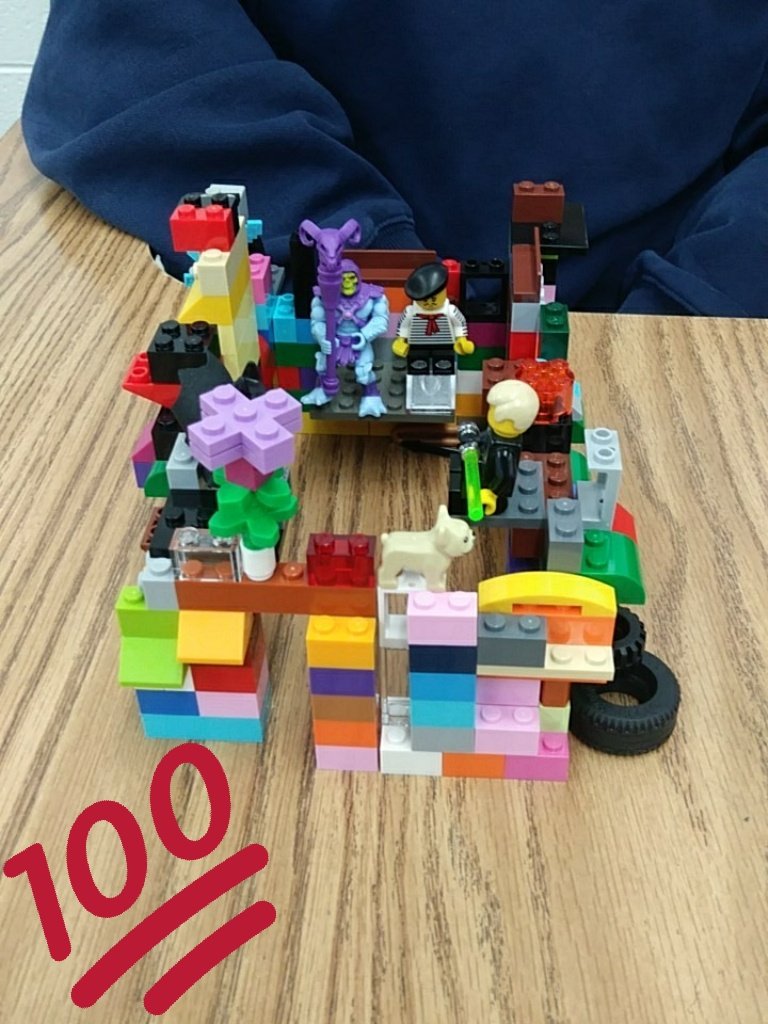

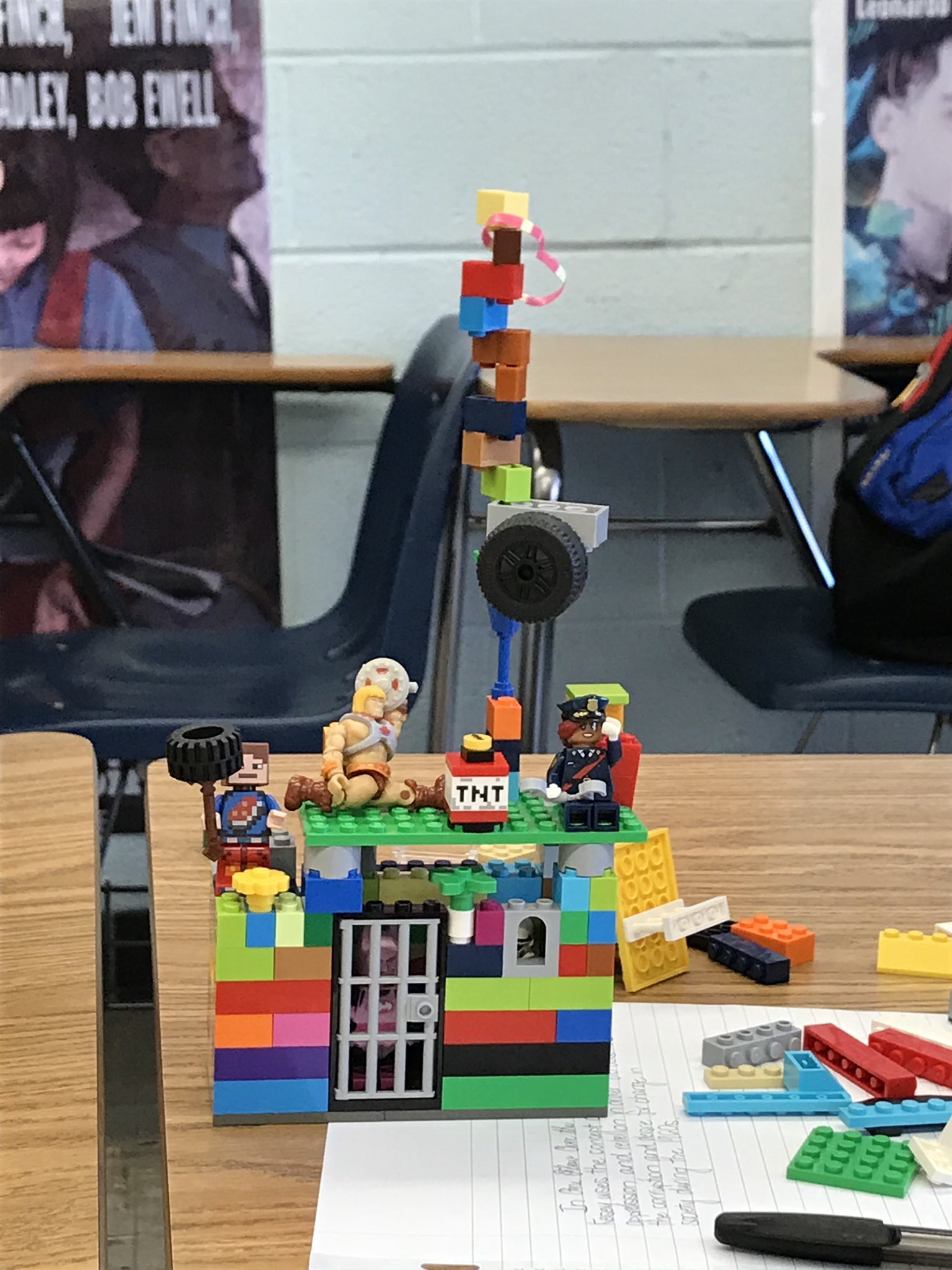
— Paul (@paulp517m) January 24, 2018
“it’s not big… but we’re bigger than life.” – Little Wolverine. @MeehanEnglish #justLegoThings #DreamRush pic.twitter.com/8zpIuPQeGK— Audrey (@AudreyP517M) January 24, 2018
Answer: we all win. Students have a blast completing an activity that might otherwise have been an educational death march. And like 99% of my grading is already done before the class is over.
Even better —
The gameplay is specifically designed to reward and validate students for demonstrating their knowledge of what constitutes only the highest quality note cards. Through the activity’s perpetual kinesthetic nature and teamwork-driven mechanics, even students who might not have had 100% top quality note cards still get to spend a day literally scouring through HUNDREDS of examples of peer work products, which reteaches the value of using note cards as “building blocks” for long-form research — and makes that assignment grade of 35/50 a heckuva lot easier to swallow since we’ve spent an entire class period demonstrating the connection between what a note card is and the precise function that it’s designed to do.
And THAT is something that everyone can build on.
Even better —
The gameplay is specifically designed to reward and validate students for demonstrating their knowledge of what constitutes only the highest quality note cards. Through the activity’s perpetual kinesthetic nature and teamwork-driven mechanics, even students who might not have had 100% top quality note cards still get to spend a day literally scouring through HUNDREDS of examples of peer work products, which reteaches the value of using note cards as “building blocks” for long-form research — and makes that assignment grade of 35/50 a heckuva lot easier to swallow since we’ve spent an entire class period demonstrating the connection between what a note card is and the precise function that it’s designed to do.
And THAT is something that everyone can build on.